Educators work hard to earn and keep students’ and parents’ trust. Incidents like the Instructure breach on May 7 risk losing your community’s trust and exposing students and parents to anxiety about data privacy. For institutions that rely on LMS infrastructure, there’s no need to panic— the appropriate response is diligence on data architecture, vendor dependency, and integration design.
The precise chain of compromise is still being investigated, but Instructure has confirmed unauthorized access to part of its Canvas environment through exploitation of an issue related to Free-for-Teacher accounts. ShinyHunters successfully compromised Instructure’s cloud hosting of the Canvas LMS, accessing personally identifiable information from 9,000 institutions (up to 200 million students).
The real problem wasn’t that there was a security breach. The real problem was that Instructure’s data was centralized, so a single compromise allowed an attacker to access data from all of Instructure’s clients. When data security matters, a platform’s architecture should make this difficult: a vendor should isolate different organizations’ data, tenants, permissions, and operational domains through a multi-tenant structure. This significantly reduces the blast radius of any compromise.
LMS platforms have become control panels for learning operations, including identity, enrollments, grades, submissions, communications, accommodations, analytics, integrations, and institutional workflows. That makes them valuable, but it also makes them dangerous. Every new workflow absorbed into the LMS increases the consequences of compromise. The business model of an LMS requires being the system of record for institutional data, driving engagement and switching costs.
That’s why the Instructure incident is an infrastructure story. Education has concentrated too much operational dependency inside monolithic systems of record. Instead of more SaaS tools, education needs infrastructure that works across existing systems to meet students and administrators where they are and allow organizations to keep their own data under their own security policies. Educational institutions shouldn’t be forced to surrender operational sovereignty to participate in AI-native learning.
The problem with LMS platforms is a business model that rewards engagement, lock-in, and central data collection. With AI, we can now effectively build outcomes-based contracts, where vendors are paid for meeting learning and job outcomes set by the institution. Digital Promise found that outcome-based contracts can increase student adoption from 35% to 50%-95%.
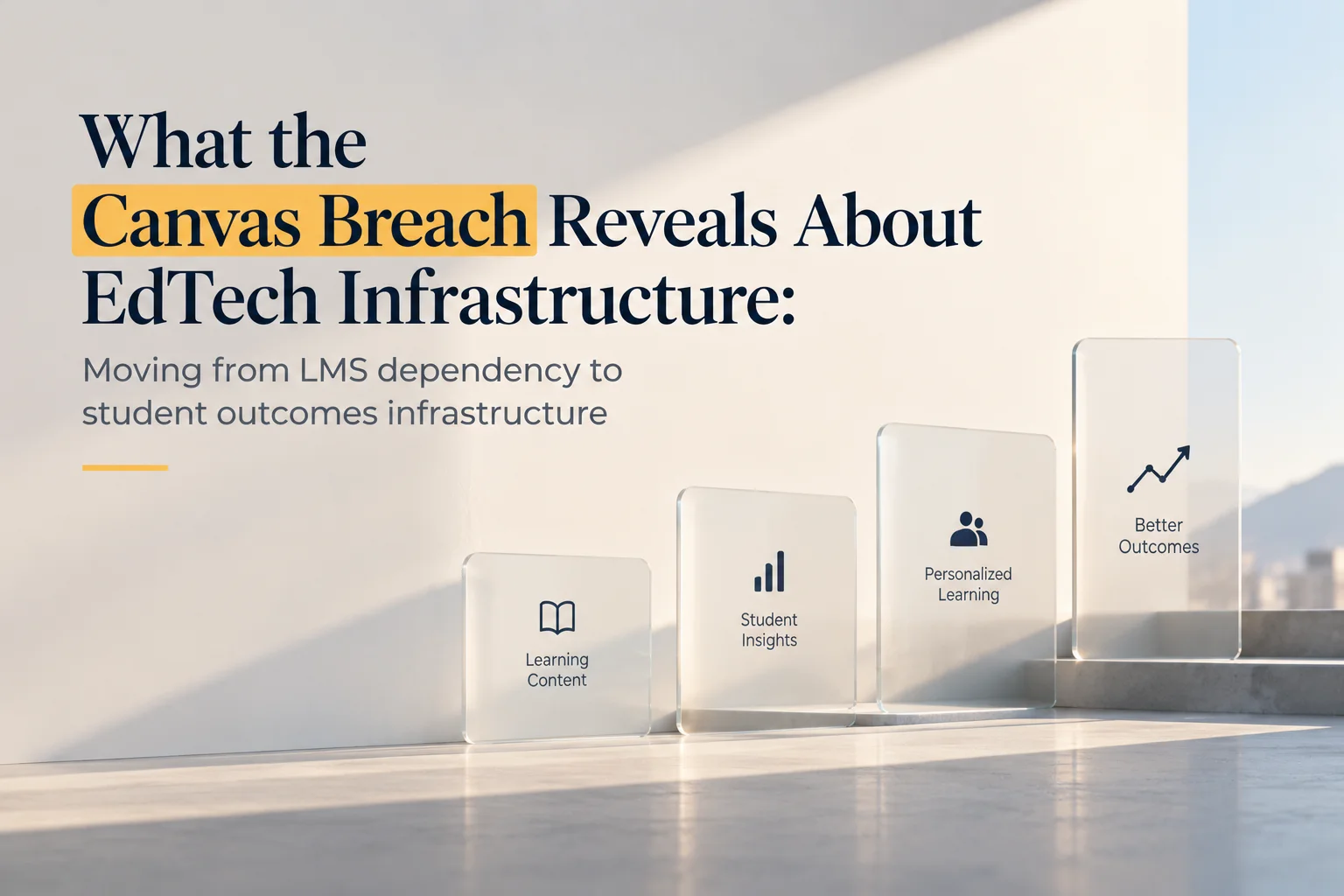
Rather than pricing per seat, outcome engines price on the achievement of learner outcomes defined by the institution. An outcomes engine is an instructional execution layer that delivers learning interactions, captures evidence of mastery, evaluates that evidence, and writes verified results to the institution’s existing systems of record. The point isn’t to replace one system of record with another— the point is to design the instructional layer to be institution-scoped and integrated into existing records rather than becoming the record itself. The model is an integrated agent harness, rather than a walled garden.
An outcomes engine does not need to store a decade of data to do its work. The data footprint shrinks, and the blast radius of a compromise shrinks with it. And the vendor's incentive can match the institution's because the value delivered is measurable.
The switching costs to transition to a new platform have narrowed faster than most institutions realize: AI-assisted migration now handles the schema mapping and integration work that used to take a year. Open-source LMS options, including Canvas and Moodle, reduce vendor lock-in and can preserve familiar workflows.
The sector has been through this kind of transition before. Universities ran their own mainframe student systems for years after cloud SIS made local hosting indefensible. The shift now underway is the same kind, as per-seat access to a cloud-hosted database is giving way to per-outcome learning infrastructure. Institutions, operators, teachers, students, and outcome vendors all share an incentive in rapidly moving to outcome-based pricing and technology adoption.
The right question is not how to secure the LMS. The right question is how to rethink the role of the LMS in an AI-first world where human capital development must be redesigned around outcomes.