Communicative Language Teaching
People learn a language by using it for a purpose. Lessons recreate authentic situations, from meeting a host family to leading a work meeting.

Jinso is an AI learning platform that connects to your institution's curriculum and systems. It brings content creation, practice, feedback, assessment, and learning evidence together in one place, so your team can see how every student is progressing and step in while there's still time to help.
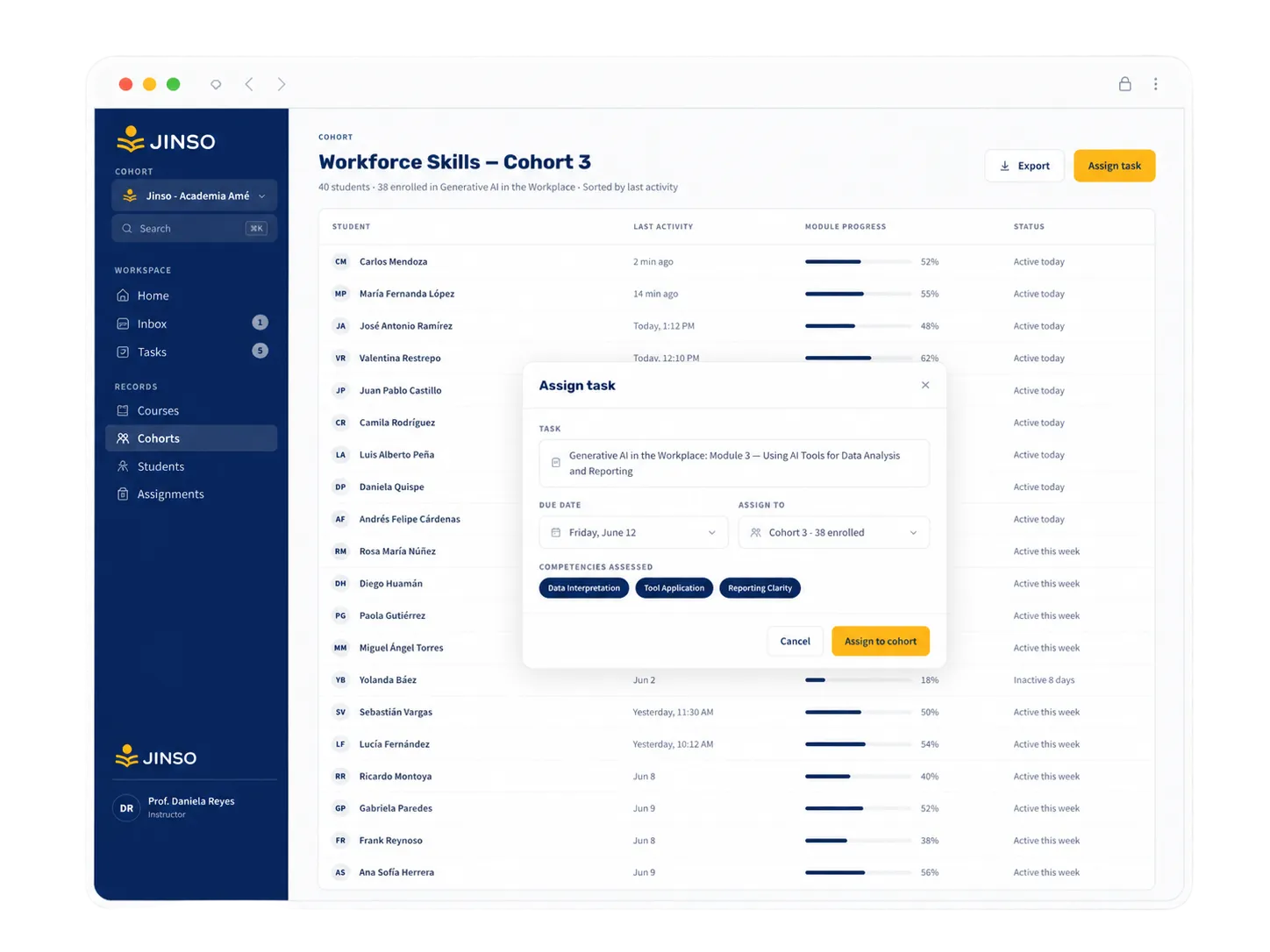
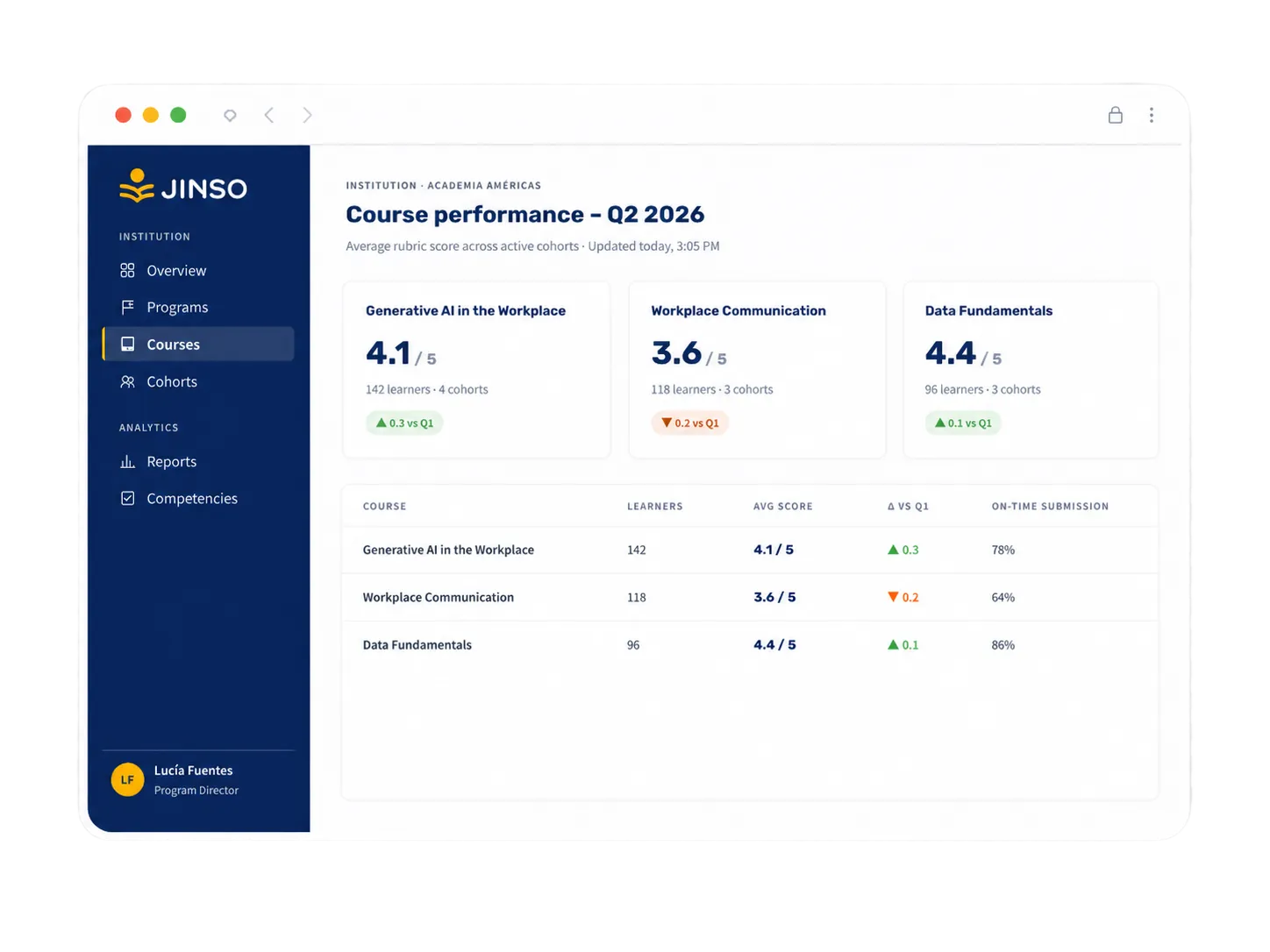
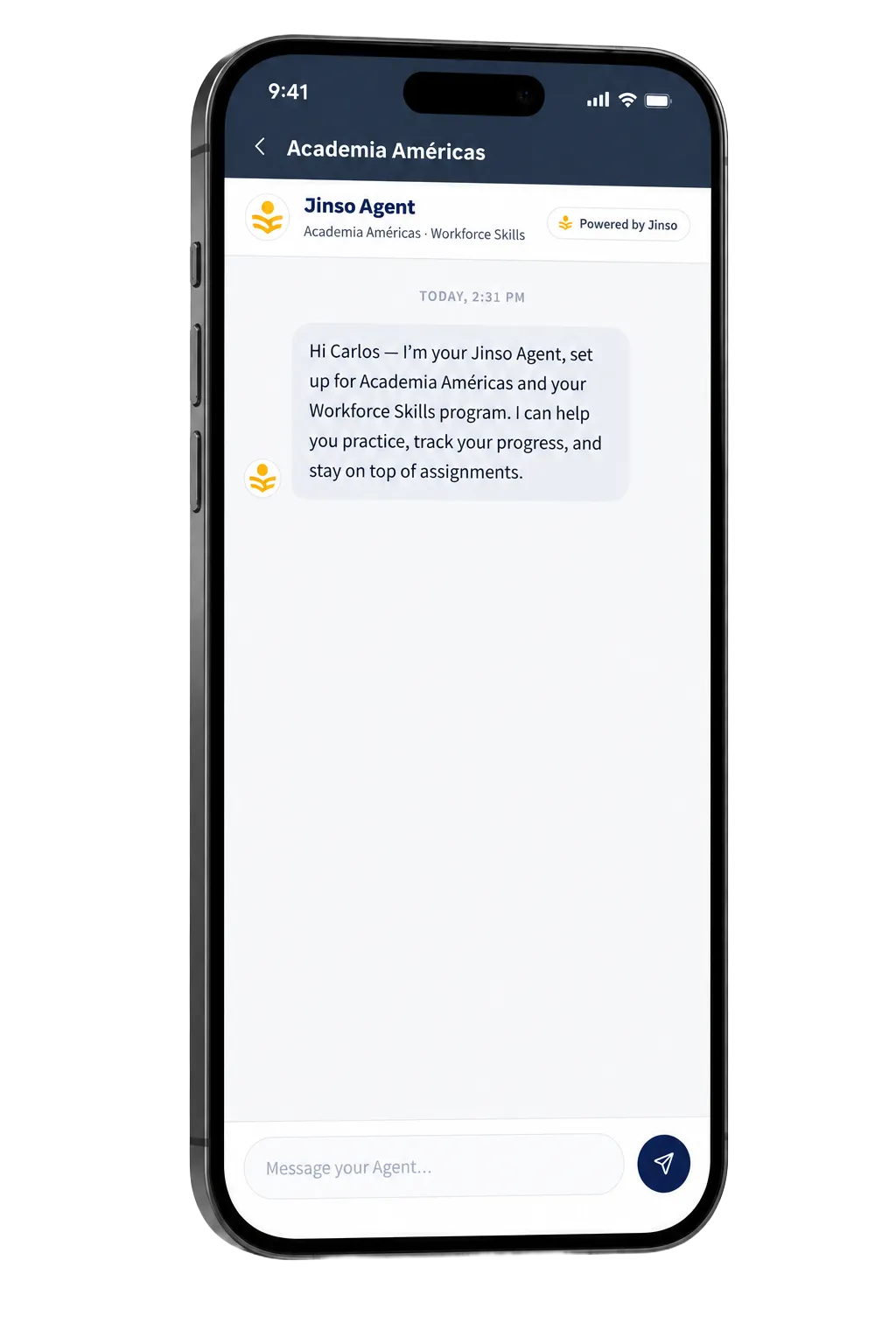
Jinso works as a closed loop. Your institution sets the learning goals. Students practice toward them. Jinso measures what each student can do, and your team uses that evidence to shape what comes next. Then the cycle begins again, sharper each time.
The loop exists so you learn about a gap while it's still small enough to close.
Jinso's method comes from applied linguistics and instructional design, and rests on three frameworks your academic team will recognize:
People learn a language by using it for a purpose. Lessons recreate authentic situations, from meeting a host family to leading a work meeting.
Every module ends with a concrete task, such as a recorded pitch, an email, or a short report, so learners prove they can use the language to get something done.
Each unit starts from the outcome (a CEFR can-do statement, a competency, or an employability benchmark) and works back to the activities that get learners there.
Jinso organizes learning into a repeatable cycle of concept, practice, and assessment.
The skill or language point is introduced through readings, videos, models, and scenarios, adapted to each learner's level. Learners understand both the form and the purpose of what they're about to practice.
Learners apply it through guided exercises, simulations, and role-plays with instant feedback. Support fades as confidence grows, and practice happens privately, so no one has to make mistakes in front of classmates.
Each learner produces something tangible, like an audio response, a short video, or a written piece. It's scored against clear rubrics, with an example from their own work and a concrete next step. Teachers always keep the final say.
A new concept introduced through reading, video, or an AI simulation.
Spoken or written practice with AI characters, like a teammate, a client, or a host family.
Focused questions that pinpoint what a learner has mastered and what still needs work.
A video, audio, or written sample showing they can use the skill in a real-world situation.
An adaptive test that places each learner on your standards.
Checkpoints that track progress on specific skills or confirm a level.
Here's how a unit on running a team meeting might look:
Learners watch two meetings, one chaotic and one well run, and reflect on the language that made the difference.
They lead a simulated meeting where AI characters play teammates and a supervisor, asking questions and pushing back as it unfolds.
They record a 90-second video opening a meeting, summarizing agreements, and closing it. Rubrics score the result, and coordinators see how the whole group performed.
The same structure works for any goal, from ordering at a restaurant to preparing for a university interview.
Jinso's AI never works in a vacuum. Every response draws on four sources: your approved materials and instructions, the objective of the current lesson, what the learner has shown so far, and the conversation in progress.

That lets it respond differently to each student while staying within your syllabus, level, and sequence. A beginner gets simpler prompts and more explanation. A stronger learner gets harder scenarios. Over time, difficulty moves from single words to full sentences, connected speech, and spontaneous conversation.
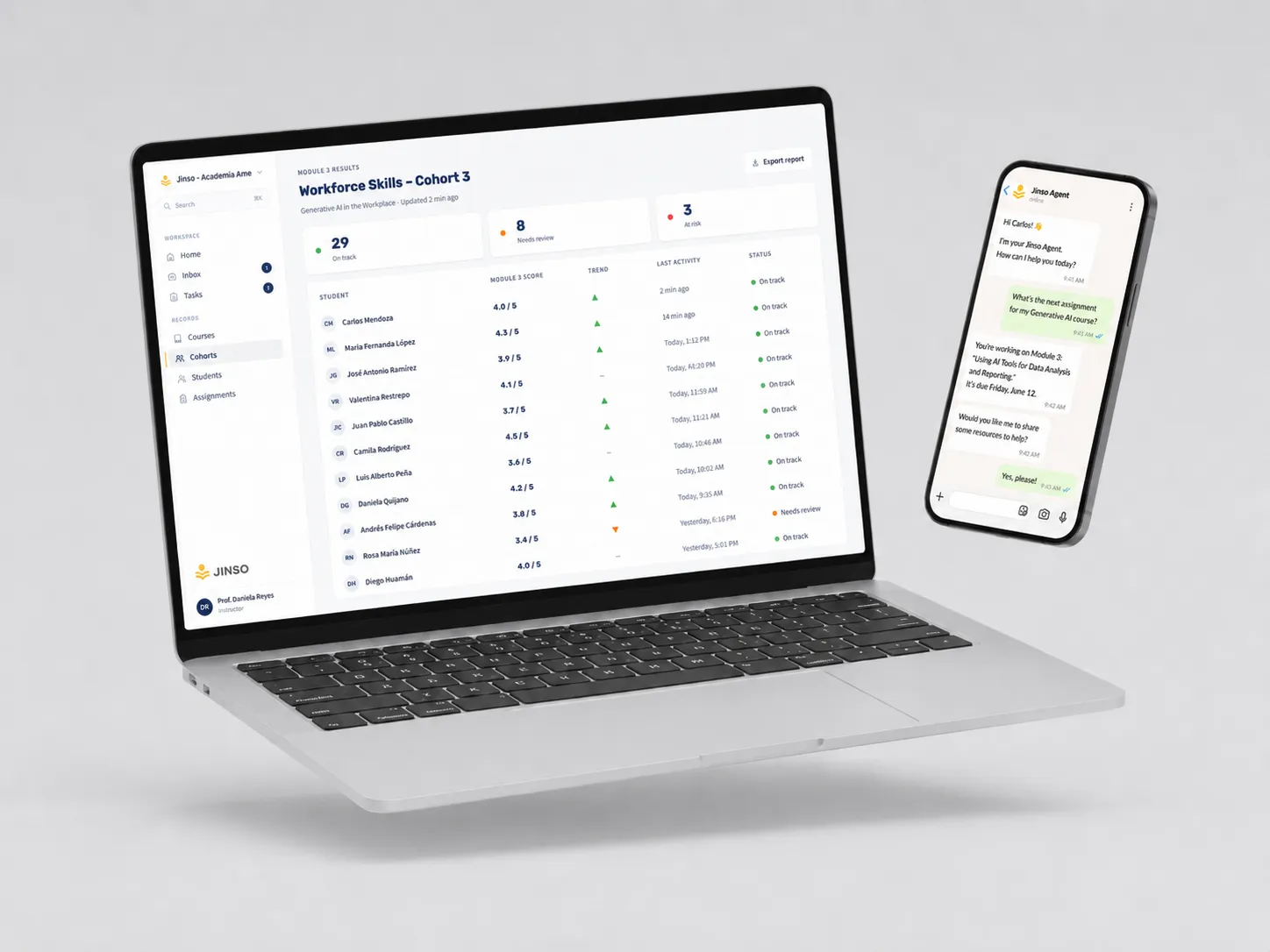
Jinso delivers practice through WhatsApp, so students can learn on a basic phone without downloading anything. It also connects to Canvas, Moodle, Google Classroom, and other LMS platforms. Reminders keep students on track, and every activity links back to their course.
Every interaction adds to a clear picture of learning, at every level of your institution. Teachers and leaders can also ask Jinso's AI questions about their data and get answers on demand.
Level, sessions completed, and skills like pronunciation, fluency, grammar, and vocabulary, plus strengths, areas to improve with examples, and suggested next steps.
Activity, performance, and who needs attention. When many students miss the same point, Jinso proposes a response for teachers to approve.
Adoption, proficiency across levels, and trends over time, so leaders can see which programs are working and where to invest next.
Jinso adapts to your systems, not the other way around.
Keep it. Your LMS organizes and delivers courses. Jinso adds what happens inside them: richer activities, AI support, rubric scoring, feedback, and a clear view of performance. You don't have to start over.
It tells you how a student performed. Jinso ties that score to practice, feedback, and follow-up, so someone can act on it.
You can. Jinso also works as a complete standalone platform, with no separate LMS needed. Courses, practice, assessment, and reports all live in one place.
Jinso is fully white-labeled. Students see your institution's name, logo, and colors, so it feels like part of your program from day one.
Build stronger activities, support students between classes, and use the work they produce to make better decisions.